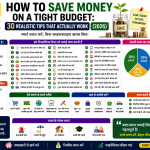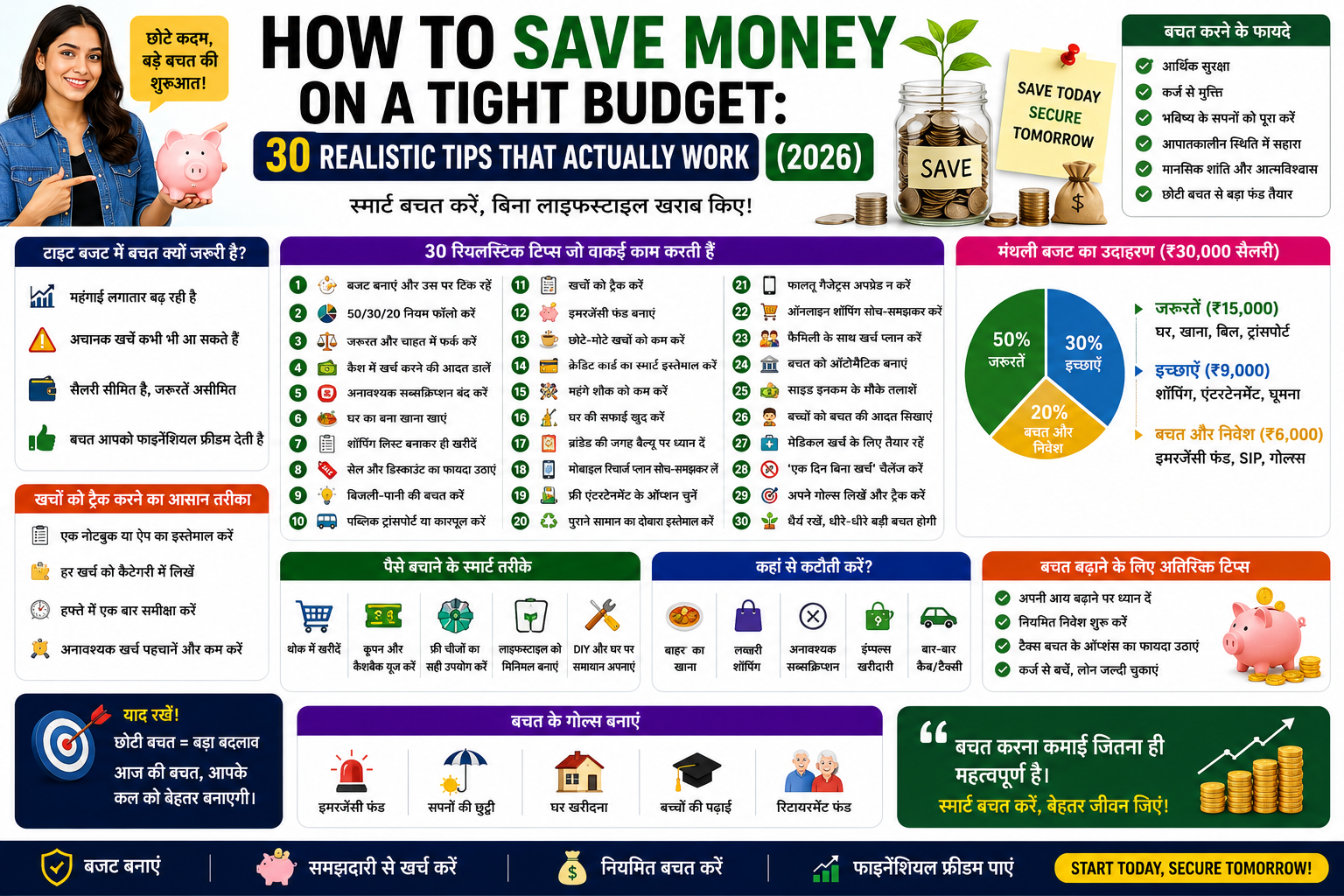
How to save money on a tight budget starts with one simple mindset shift – you do not need to earn more to save more. You just need to spend less on things that do not matter. The 50/30/20 rule is a great starting point: 50% of your income goes to needs (rent, groceries, bills), 30% to wants (eating out, subscriptions, entertainment), and 20% to savings and debt repayment. But when your budget is tight, even saving 5-10% is a win.
Start by tracking every rupee for one month. You will be shocked where your money goes. Cancel unused subscriptions. Cook at home instead of ordering in. Use public transport instead of cabs. Buy generic brands instead of fancy labels. Sell things you do not use. Negotiate your bills. Use the 24-hour rule before any non-essential purchase. This guide gives you 30 realistic, actionable tips to save money on a tight budget – without feeling like you are depriving yourself.
You Can Save Money Even When Money Is Tight
I have been there. You look at your bank account at the end of the month. There is almost nothing left. You wonder where all the money went. You think “I cannot save. I barely have enough to survive.”
Here is the truth I learned the hard way. Saving money has very little to do with how much you earn. It has everything to do with what you do with what you earn.
I have seen people earning ₹25,000 a month save ₹5,000 consistently. I have seen people earning ₹1,50,000 a month save nothing. The difference is not income. The difference is habits.
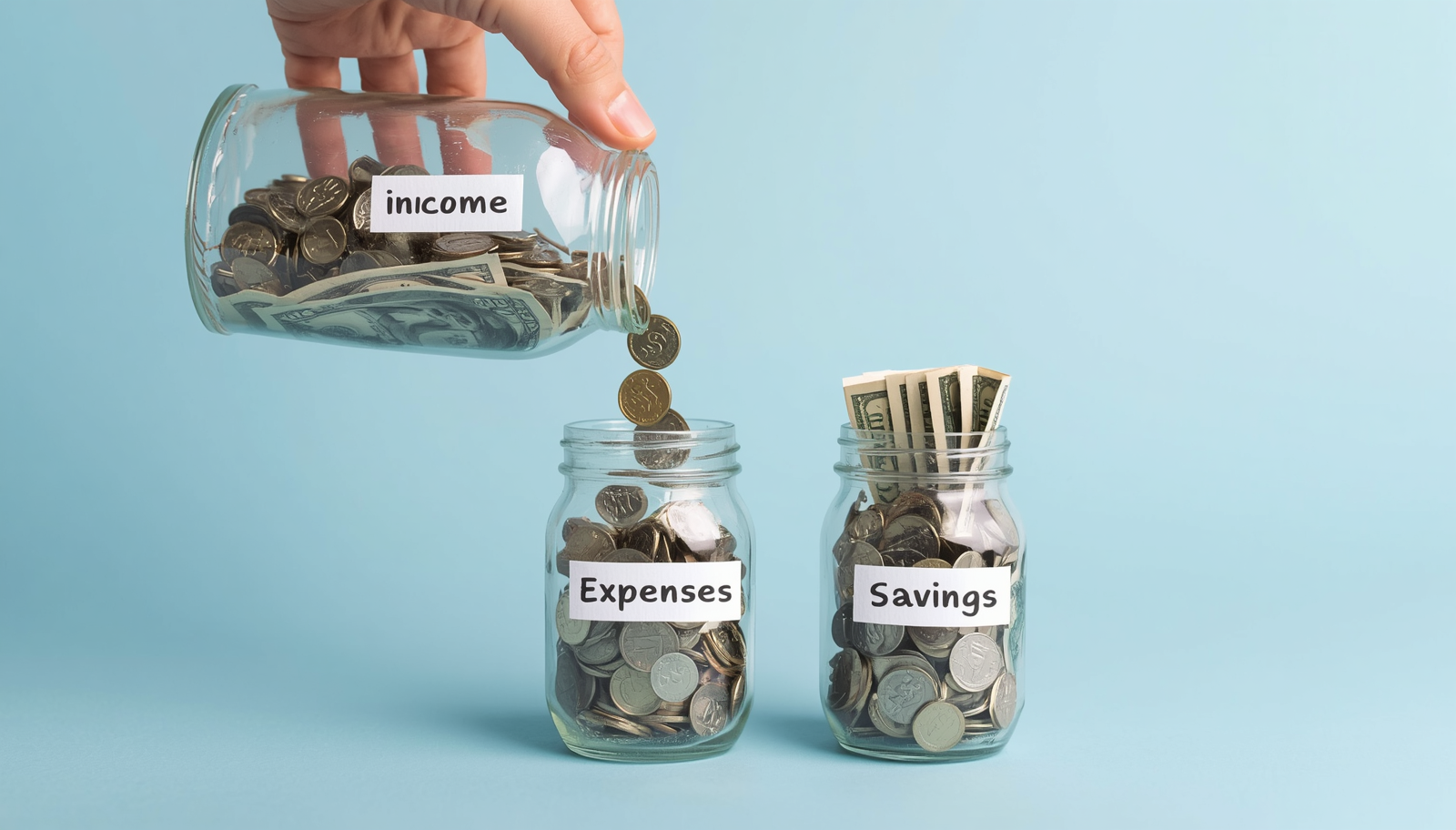
This guide is not for people who earn six figures and want to save more. This guide is for the student with a small allowance. For the young professional paying off education loans. For the single parent juggling bills. For anyone who looks at their bank balance and feels helpless.
I promise you. You can save money on a tight budget. You do not need to earn more. You just need to spend differently. Let me show you exactly how.
How To Save Money On A Tight Budget: 30 Realistic Ways
Track Every Rupee For 30 Days (The Awareness Step)
You cannot fix what you do not measure. Before you change anything, know where your money goes.
How to do it:
- Download a expense tracker app (Money Manager, Walnut, or even a simple notebook)
- Write down EVERY expense – that chai from the roadside stall, that ₹10 for parking, everything
- Do this for 30 days without changing your habits
What you will discover:
- You spend ₹500-1000 on chai and coffee outside every month
- You have 3-4 subscription services you forgot about (Netflix, Prime, Spotify, Gym)
- You buy small things daily that add up to big amounts monthly
The truth: Most people who struggle to save do not have an income problem. They have an awareness problem. Track first. Then fix.
Follow The 50/30/20 Rule (Modified For Tight Budgets)
The standard 50/30/20 rule says:
- 50% for needs (rent, groceries, utilities, transport)
- 30% for wants (dining out, shopping, entertainment)
- 20% for savings and debt
But when your budget is tight, you cannot save 20%. That is fine.
Modified for tight budgets:
- 60-70% for needs
- 20% for wants
- 10-20% for savings (even ₹500-1000 counts)
Example on ₹20,000 monthly income:
| Category | Percentage | Amount |
|---|---|---|
| Needs (rent, food, bills, transport) | 65% | ₹13,000 |
| Wants (eating out, entertainment) | 20% | ₹4,000 |
| Savings (start small) | 15% | ₹3,000 |
Do not get discouraged if you cannot save 20%. Saving 5% is better than saving 0%. Start where you are.
Automate Your Savings (Even ₹100)
Here is a psychological trick. If money stays in your account, you will spend it. If you move it to savings first, you will not miss it.
How to automate:
- Set up a recurring transfer from your salary account to a separate savings account
- Do this on the day you receive your salary (not at the end of the month)
- Start with as little as ₹500 or ₹1000
Why it works:
You cannot spend what you do not see. After a few months, you will not even notice the money leaving. Your spending will adjust automatically.
Pro tip: Open a separate savings account that is NOT linked to your UPI or debit card. Make it slightly inconvenient to access. You will think twice before withdrawing.
Cook At Home (The Single Biggest Saving)
This is not new advice. But let me give you real numbers.
| Meal | Eating Out Cost | Home Cooked Cost | Monthly Saving (30 days) |
|---|---|---|---|
| Breakfast | ₹80-150 | ₹15-25 | ₹1,950-3,750 |
| Lunch | ₹150-300 | ₹40-60 | ₹3,300-7,200 |
| Dinner | ₹150-300 | ₹40-60 | ₹3,300-7,200 |
| Total | ₹380-750/day | ₹95-145/day | ₹8,550-18,150/month |
You can save ₹8,000-18,000 every single month just by cooking at home. That is not small change. That is rent money for many people. Compare Term Life Insurance Plans in India – Best Policies, Premiums & Benefits (2026)
Easy home cooking for beginners:
- Meal prep on Sundays (cook rice, dal, sabzi for 3-4 days)
- Keep frozen vegetables and rotis for quick meals
- Learn 5-10 simple recipes and rotate them
Cancel Unused Subscriptions (The Silent Money Drain)
Most people have no idea how much they spend on subscriptions. Check your bank statement. You will be surprised.
Common unused or forgotten subscriptions:
- Gym membership you have not used in 6 months
- Netflix, Prime, Hotstar, Zee5, SonyLIV (do you need all five?)
- Spotify or Apple Music (use free version with ads)
- Monthly app subscriptions (photo editors, note-taking apps, VPNs)
- Magazine or newspaper digital subscriptions
Action step:
- Open your bank statement for the last 3 months
- Circle every subscription charge
- Ask yourself: “Have I used this in the last 30 days?”
- Cancel everything with a “No” answer
Average savings: ₹2,000-5,000 per month
Use The 24-Hour Rule Before Any Non-Essential Purchase
This single habit changed my spending forever.
The rule: Whenever you want to buy something that is not a necessity (new clothes, gadgets, eating out, random Amazon purchase), wait 24 hours.
What happens in those 24 hours:
- The initial excitement fades
- You realize you do not actually need it
- You remember you have something similar at home
- You find a better price or alternative
Example: You see a nice shirt for ₹1,500. Instead of buying immediately, put it in the cart and wait. The next day, you remember you already have 3 similar shirts. You close the tab. You saved ₹1,500. This is the best step, when it comes to How To Save Money On A Tight Budget.
Exceptions: Groceries, medicines, emergency items, essential repairs.
Buy Generic Brands (Stop Paying For Packaging)
You are not paying for quality. You are paying for packaging and advertising.
Products where generic is exactly the same:
| Category | Brand Price | Generic/Store Brand Price | Saving |
|---|---|---|---|
| Medicines (same composition) | ₹200 | ₹80-100 | 50-60% |
| Staples (rice, dal, flour, sugar) | ₹100/kg | ₹70-80/kg | 20-30% |
| Over-the-counter medicines (paracetamol, antacids) | ₹50 | ₹15-20 | 60-70% |
| Cleaning products (bleach, soap) | ₹60 | ₹30-35 | 40-50% |
| Packaged foods (biscuits, noodles) | ₹40 | ₹25-30 | 25-35% |
Where to buy generic brands:
- Medicines: Generic medicine stores (Jan Aushadhi Kendras have the lowest prices)
- Groceries: Local kirana stores (they have cheaper unbranded options)
- Household items: DMart, local super markets (store brands)
Use Public Transport Or Share Rides
Owning a vehicle is expensive. Using it for every trip is even more expensive.
Cost comparison per month (for someone traveling 30 km daily):
| Mode | Monthly Cost | Annual Cost | 5-Year Cost |
|---|---|---|---|
| Own car (fuel + maintenance + EMI) | ₹8,000-15,000 | ₹96,000-1,80,000 | ₹4,80,000-9,00,000 |
| Own bike/scooter | ₹3,000-5,000 | ₹36,000-60,000 | ₹1,80,000-3,00,000 |
| Auto/Cab daily | ₹6,000-10,000 | ₹72,000-1,20,000 | ₹3,60,000-6,00,000 |
| Public bus | ₹1,500-2,500 | ₹18,000-30,000 | ₹90,000-1,50,000 |
| Metro | ₹2,000-3,500 | ₹24,000-42,000 | ₹1,20,000-2,10,000 |
| Shared auto/rickshaw | ₹2,500-4,000 | ₹30,000-48,000 | ₹1,50,000-2,40,000 |
Switching from a car to public transport can save you ₹5,000-10,000 per month. That is ₹60,000-1,20,000 per year. That is a lot of money. Explore more about Zero Balance Savings Account for Students 2026 | Student Guide
If you must use a vehicle:
- Carpool with colleagues (split fuel costs)
- Use a bike/scooter instead of a car for short trips
- Walk or cycle for distances under 2 km
Negotiate Your Bills (Yes, You Can)
Most people do not know this. You can negotiate almost every monthly bill.
Bills you can negotiate:
| Bill | What to say | Typical saving |
|---|---|---|
| Internet/Cable | “I am thinking of switching to [competitor name]. Can you offer me a better rate?” | ₹200-500/month |
| Mobile plan | “I do not need this much data. Do you have a cheaper plan?” | ₹100-300/month |
| Gym membership | “I cannot afford the renewal fee. Can you give me a discount?” | ₹500-2,000/year |
| Insurance premium | “I got a lower quote from another company. Can you match it?” | ₹1,000-5,000/year |
| Credit card annual fee | “Please waive the annual fee or I will close the card.” | ₹500-3,000/year |
Pro tip: Be polite but firm. The customer service agent has the power to give discounts. They just need a reason. Give them one.
Sell What You Do Not Use (One-Time Boost + Declutter)
Every Indian household has stuff they do not use. Old phones, clothes that do not fit, books never read, kitchen appliances in boxes.
Where to sell:
| Item | Platform | Expected Price (Used) |
|---|---|---|
| Old smartphone (2-3 years old) | OLX, Cashify, Facebook Marketplace | ₹3,000-8,000 |
| Clothes in good condition | Poshmark, local thrift stores, OLX | ₹100-500 per piece |
| Books | BookChor, OLX, library donations | ₹50-200 per book |
| Furniture | OLX, Facebook groups | 30-50% of purchase price |
| Kitchen appliances | OLX, local second-hand shops | 30-40% of purchase price |
| Bicycle | OLX, local bicycle shops | 40-60% of purchase price |
Action step: This weekend, go through your house. Make three piles – Keep, Sell, Donate. Take photos of the Sell pile. Post on OLX or Facebook Marketplace. Use the money for savings or debt repayment.
Use The “Envelope Method” For Variable Expenses
This is an old-school method that still works brilliantly. How To Save Money On A Tight Budget right way.
How it works:
- Decide how much you can spend on categories like groceries, eating out, entertainment, transport
- Withdraw that amount in cash at the start of the month
- Put the cash in separate envelopes labeled with each category
- Once an envelope is empty, you cannot spend more in that category
Why cash works better than cards:
- You feel the pain of giving away physical money
- You cannot overspend because the envelope is empty
- No surprise credit card bills at the end of the month
Digital alternative: Use a separate bank account or wallet for variable expenses. Load only your budgeted amount at the start of the month.
12. Stop Buying Bottled Water (Carry Your Own)
You spend money every day on something you can get for almost free.
The math:
- 1 liter bottled water: ₹20
- You drink 2-3 liters daily: ₹40-60
- Monthly cost: ₹1,200-1,800
- Yearly cost: ₹14,400-21,600
The solution:
- Buy a good reusable water bottle (₹300-500 one-time cost)
- Fill it at home (filtered or boiled water)
- Carry it everywhere – office, college, travel, gym
Saving: ₹1,200-1,800 per month. ₹14,400-21,600 per year.
13. Plan Your Grocery Shopping (Never Shop Hungry)
Impulse purchases at the grocery store destroy budgets. Here is how to stop.
The 5-step grocery plan:
| Step | Action | Why it works |
|---|---|---|
| 1 | Check what you already have at home | You stop buying duplicates |
| 2 | Make a list of what you actually need | You buy only what is on the list |
| 3 | Eat before you go shopping | Hunger makes you buy unnecessary snacks |
| 4 | Stick to the list | No random chips, cookies, or branded items |
| 5 | Go alone (leave family at home) | Fewer people = fewer impulse requests |
Average saving: ₹1,000-3,000 per month
14. Use The Library Instead Of Buying Books
Book lovers, this one is for you.
| Type of book | Purchase price | Library cost | Saving |
|---|---|---|---|
| Fiction novel | ₹300-600 | ₹0 (library membership ₹500-1000/year) | ₹300-600 per book |
| Academic textbook | ₹500-2,000 | ₹0 (many libraries have reference copies) | ₹500-2,000 per book |
| Magazine | ₹150-300 per issue | ₹0 | ₹150-300 per issue |
Where to find free books:
- Public libraries (your city’s public library)
- College libraries (as a student or alumni member)
- Digital libraries (Internet Archive, Open Library)
- Book exchanges (swap books with friends)
- Kindle Unlimited (free trial for 30 days)
15. Unsubscribe From Marketing Emails (Stop Temptation)
Here is a psychological trick. You cannot spend money on things you do not know exist.
Why marketing emails hurt your budget:
- “50% off today only!” creates false urgency
- “Limited time offer!” makes you buy things you do not need
- “Recommended for you” makes you want things you never thought of
Action step:
- Every time you get a marketing email, click “Unsubscribe” at the bottom
- Do this for one week
- After that, you will only get essential emails
Result: Less temptation = less impulse spending = more savings.
16. Use Cashback And Rewards Apps (Earn While You Spend)
You are going to spend money anyway. You might as well get something back.
Best cashback apps in India:
| App | How it works | Typical cashback |
|---|---|---|
| CRED | Pay credit card bills | ₹20-200 per payment |
| Paytm | Pay bills, recharge, shop | 1-5% |
| Amazon Pay | Pay bills, shop on Amazon | 1-2% |
| Flipkart | Shop on Flipkart | 1-5% in SuperCoins |
| CashKaro | Shop through their links | 5-20% on partner stores |
| Groww | Invest in mutual funds | ₹100-500 cashback on first investment |
Important: Only use these for purchases you were already going to make. Do NOT buy something just because there is cashback.
17. Practice “No-Spend Days” (Start With 4 Days A Month)
A no-spend day means you do not spend any money. Not a single rupee.
How to start:
- Choose 4 days in a month (one day each weekend)
- On those days, you cannot spend on anything except absolute emergencies
- No eating out, no online shopping, no random chai from the shop
What you learn:
- Most of your daily spending is not necessary
- You can survive and even enjoy yourself without spending
- You start differentiating between wants and needs
Potential saving: ₹500-2,000 per month
18. Repair Instead Of Replace
We live in a throwaway culture. Something breaks, we buy a new one. That is expensive.
Items you can repair (instead of replacing):
| Item | Replacement cost | Repair cost | Saving |
|---|---|---|---|
| Mobile screen | ₹5,000-15,000 | ₹1,500-4,000 | 70-75% |
| Shoes (sole coming off) | ₹1,000-3,000 | ₹150-300 | 80-90% |
| Geyser/electric appliance | ₹3,000-8,000 | ₹500-2,000 | 60-75% |
| Laptop battery | ₹5,000-8,000 | ₹2,000-3,500 | 50-60% |
| Clothing (zipper, button, hem) | ₹500-2,000 | ₹50-200 | 80-90% |
Where to find repair shops:
- Local markets (every city has a repair market – Nehru Place in Delhi, SP Road in Bangalore)
- Ask neighbors for recommendations
- YouTube tutorials for small repairs (changing a phone battery, fixing a shoe)
19. Take Advantage Of Student And Senior Discounts
If you are a student or a senior citizen, you are leaving money on the table.
Discounts you might be missing:
| Category | Discount | How to get |
|---|---|---|
| Train tickets | 50% in sleeper/3AC (students), 40% (seniors) | Show student ID or senior citizen ID at booking |
| Bus tickets | 25-50% in state transport | Student ID card |
| Movie tickets | ₹50-100 off | Student ID at box office |
| Museums and monuments | 50-90% off | Student ID or senior citizen ID |
| Software subscriptions | 50-70% off | Student email address (.edu) |
| Gym memberships | 20-30% off | Student ID or senior card |
Always ask: Before paying full price, ask “Do you offer a student/senior discount?” You will be surprised how often the answer is yes.
20. Use The “One In, One Out” Rule (Stop Accumulating)
This rule prevents you from buying new things you do not need.
The rule: Every time you buy something new, you must sell, donate, or throw away one similar item you already own.
Example:
- Want to buy a new pair of shoes? You must get rid of one old pair.
- Want to buy a new shirt? You must donate one shirt you do not wear.
- Want to buy a new kitchen gadget? You must sell one gadget you never use.
Why it works:
- You think twice before buying because you have to give something up
- Your house stays clutter-free
- You stop accumulating things you do not need
21. Batch Your Errands (Save Fuel And Time)
Every time you take out your vehicle, you spend fuel. Every time you go to the market, you spend money.
The solution: Do everything in one trip.
Before (inefficient):
- Monday: Go to grocery store (2 km)
- Wednesday: Go to pharmacy (1 km)
- Friday: Go to vegetable market (3 km)
- Total travel: 6 km + multiple impulse purchases
After (batched):
- Saturday: Go to grocery store + pharmacy + vegetable market in one trip (3 km total)
- Total travel: 3 km + only one set of impulse purchases
Saving: Fuel + reduced impulse spending = ₹500-1,500 per month
22. Switch To LED Bulbs (Lower Electricity Bills)
This is a one-time investment that pays back every month.
| Bulb type | Wattage | Monthly cost (10 hours/day) | Yearly cost |
|---|---|---|---|
| Old incandescent | 60W | ₹180 | ₹2,160 |
| CFL | 15W | ₹45 | ₹540 |
| LED | 7W | ₹21 | ₹252 |
Per bulb annual saving: ₹2,160 to ₹252 = ₹1,908
For a house with 10 bulbs: ₹19,080 per year
Upfront cost: LED bulbs cost ₹80-150 each (₹800-1,500 for 10 bulbs). Payback period = less than 1 month.
23. Drink Water Before Meals (Small Health + Money Saving Hack)
This sounds silly. But it works.
What to do: Drink 1-2 glasses of water 15-20 minutes before every meal.
Why it saves money:
- You feel fuller before you start eating
- You eat less at restaurants (smaller portion or no starter)
- You order less food overall
Estimated saving on eating out: ₹100-300 per meal
24. Use A Water Filter Instead Of Buying Packaged Water
This is the same logic as bottled water but at home.
| Solution | One-time cost | Monthly cost | Yearly cost |
|---|---|---|---|
| Packaged water cans (5-6 cans/month) | ₹0 | ₹400-600 | ₹4,800-7,200 |
| Water filter (RO/UV) | ₹6,000-12,000 | ₹100-200 (filter change) | ₹1,200-2,400 + one-time cost |
After 1 year: Filter is cheaper.
After 2 years: Filter saves you ₹10,000+.
If you cannot afford a filter: Boil water at home. It costs almost nothing.
25. Cut Your Own Hair (Or Go To A Budget Salon)
Haircuts are expensive. And they are frequent.
| Option | Cost | Frequency | Yearly cost |
|---|---|---|---|
| Premium salon (male) | ₹500-1,000 | Every 4-6 weeks | ₹6,000-12,000 |
| Budget salon (male) | ₹100-200 | Every 4-6 weeks | ₹1,200-2,400 |
| Cut your own hair (male) | ₹500 clipper (one-time) | As needed | ₹500 + electricity |
For women: Cut frequency is lower, but salon costs are higher. Ask friends for recommendations for affordable salons. Look for beauty schools where students cut hair at 50-70% discount.
26. Borrow Instead Of Buying (For Infrequent Use)
How many times have you bought something, used it once, and never touched it again?
Items to borrow instead of buy:
| Item | Purchase price | Borrow from | Saving |
|---|---|---|---|
| Power tools (drill, saw) | ₹2,000-10,000 | Neighbor, friend, tool library | 100% |
| Party decorations | ₹500-2,000 | Friend, community group | 100% |
| Formal clothes for one event | ₹2,000-5,000 | Friend, rental service | 80-90% |
| Books | ₹300-1,000 | Library, friend | 100% |
| Camping gear | ₹5,000-20,000 | Rent from outdoor store | 70-90% |
The rule: If you will use something more than once a month, buy it. If less than once a month, borrow or rent it.
27. Use Discount Codes And Coupons (5 Minutes Saves ₹500)
Before you buy anything online, spend 2 minutes searching for coupons.
Where to find coupons:
| Website/App | Best for |
|---|---|
| CashKaro | All online shopping |
| CouponDunia | Flipkart, Amazon, Myntra, Ajio |
| GrabOn | Travel, fashion, electronics |
| Paytm | Bill payments, recharges |
| CRED | Credit card bill payments |
Browser extensions:
- Honey (automatic coupon finder)
- CouponDunia extension
Average saving: 5-15% on every online purchase
28. Use The “3-Drawer” System For Salary Day
This is a budgeting method that works automatically.
The system:
- Drawer 1 (Savings): 10-20% of salary – Transfer to savings account immediately
- Drawer 2 (Bills): 40-50% – Rent, electricity, internet, phone, insurance
- Drawer 3 (Spending): Remaining amount – Groceries, eating out, entertainment, transport
Why it works:
- You prioritize savings before spending
- You know exactly how much you can spend without guilt
- You never accidentally spend money meant for bills
29. Learn Basic DIY Repairs (YouTube Is Free)
You do not need to call an expert for everything. YouTube has a tutorial for almost every repair.
Things you can learn to fix yourself (with YouTube):
| Repair | Professional cost | DIY cost (parts only) | Saving |
|---|---|---|---|
| Leaky tap | ₹500-1,000 | ₹50-200 (washer/tape) | 80-90% |
| Clogged drain | ₹300-800 | ₹50-100 (drain cleaner/plunger) | 70-90% |
| Replacing a plug/switch | ₹300-600 | ₹50-100 (switch) | 80-85% |
| Patching a wall hole | ₹500-1,500 | ₹100-300 (putty/sandpaper) | 70-80% |
| Fixing a loose handle | ₹200-500 | ₹0 (just tighten screw) | 100% |
30. Practice Gratitude (The Free Mindset Shift)
This is the most important tip. And it costs nothing.
What to do: Every day, write down or think about 3 things you are grateful for.
Why this saves money:
- When you appreciate what you already have, you stop wanting what others have
- You realize you do not need new things to be happy
- You stop comparing yourself to people on social media
- You break the cycle of emotional spending
The truth: You do not need more money to save more. You need to want less. Gratitude is the shortcut to wanting less.
Sample Monthly Budget For A Tight Income (₹20,000)
Here is a realistic budget for someone earning ₹20,000 per month:
| Category | Amount | Percentage |
|---|---|---|
| NEEDS (₹13,000 – 65%) | ||
| Rent (shared accommodation) | ₹5,000 | 25% |
| Groceries (home-cooked meals) | ₹3,500 | 17.5% |
| Utilities (electricity, water, internet) | ₹2,000 | 10% |
| Transport (public bus/metro) | ₹1,500 | 7.5% |
| Mobile + basic phone plan | ₹500 | 2.5% |
| Medicines/Health (minimal) | ₹500 | 2.5% |
| WANTS (₹4,000 – 20%) | ||
| Eating out (2-3 times a month) | ₹1,000 | 5% |
| Entertainment (Netflix/Prime once) | ₹500 | 2.5% |
| Shopping (clothes, personal care) | ₹1,000 | 5% |
| Miscellaneous (tea, snacks, small purchases) | ₹1,500 | 7.5% |
| SAVINGS (₹3,000 – 15%) | ||
| Emergency fund | ₹2,000 | 10% |
| Future goals (courses, travel, investments) | ₹1,000 | 5% |
Total: ₹20,000
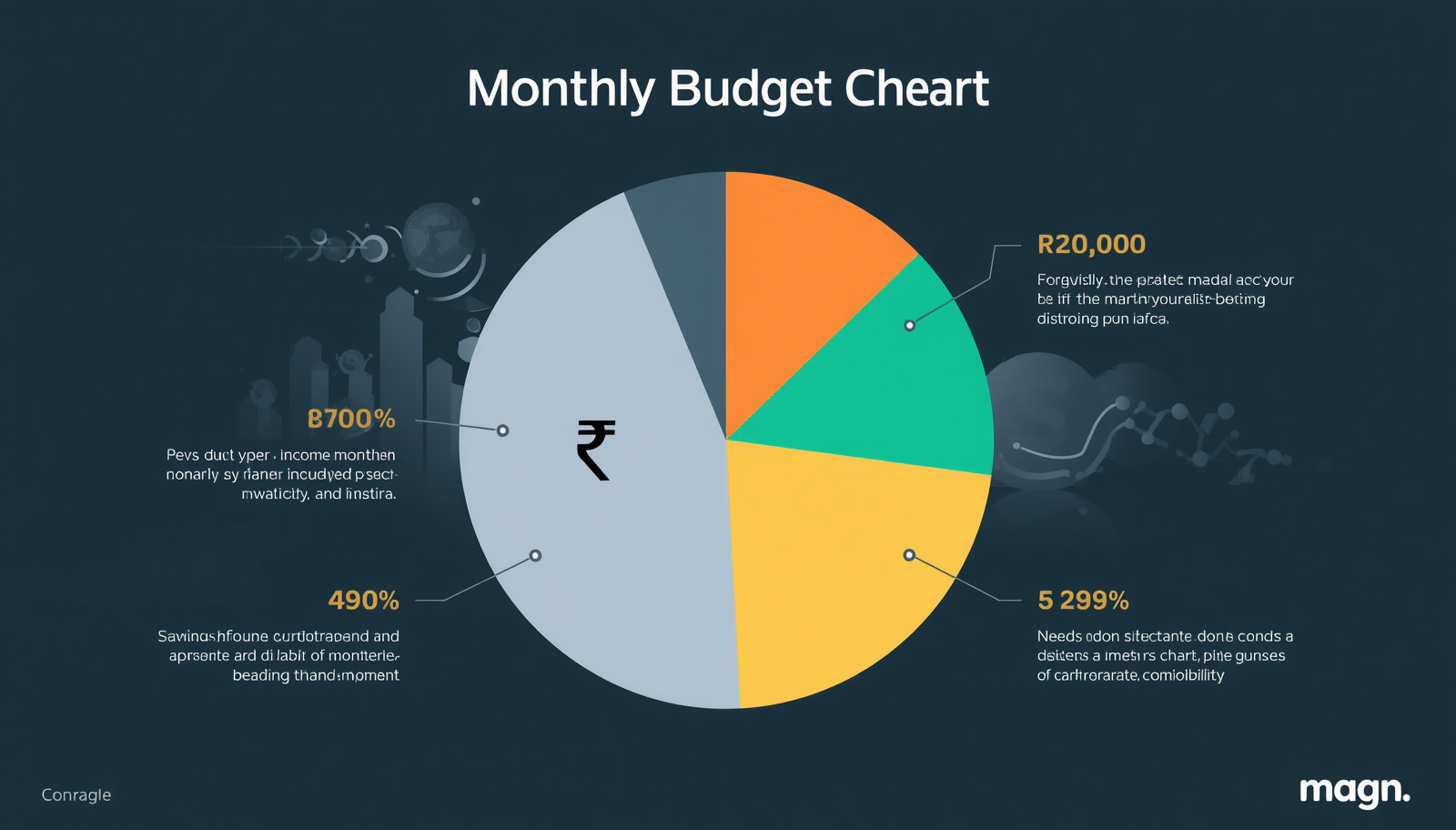
This is not a fantasy budget. This is a realistic budget that real people live on. You can do this too. Explore more about Difference Between Term Plan and Life Insurance: कौन सा बेहतर है? Complete Details In Hindi.
Frequently Asked Questions (FAQ)
How much should I save from a tight budget?
Even saving 5-10% is a win. On ₹20,000 income, start with ₹1,000-2,000 per month. Once your income increases, increase your savings percentage. The habit of saving is more important than the amount.
What is the 50/30/20 rule for tight budgets?
The standard rule is 50% needs, 30% wants, 20% savings. For tight budgets, modify to 60-70% needs, 20% wants, 10-20% savings. The exact percentages matter less than actually following a budget.
How can I save money when I have debt?
Prioritize high-interest debt first (credit cards, personal loans). Pay minimum on other debts. Save a small emergency fund (₹10,000-20,000) while paying debt. Then aggressively pay off debt. Once debt is gone, redirect that payment to savings.
Is it possible to save money on minimum wage?
Yes. It is harder, but possible. Focus on the zero-cost tips – cancel subscriptions, cook at home, use public transport, practice no-spend days, borrow instead of buy. Even ₹500 per month saved is better than zero.
What is the fastest way to save money on a tight budget?
Cancel subscriptions, cook at home, switch to public transport, buy generic brands. These four changes can save ₹5,000-15,000 per month without changing your lifestyle dramatically.
How do I stop impulse buying?
Use the 24-hour rule (wait before buying). Unsubscribe from marketing emails. Delete shopping apps from your phone. Use cash instead of cards. Make a shopping list and stick to it. These methods reduce impulse purchases by 50-70%.
Conclusion: Start Saving Today. One Tip At A Time.
You now know how to save money on a tight budget. You have 30 actionable tips. You do not need to do all 30 at once.
Start with these 5 this week:
- Track every expense for 7 days
- Cook at home for 4 days this week
- Cancel 2 subscriptions you do not use
- Switch to public transport for 3 days
- Use the 24-hour rule before any non-essential purchase
Next week, add 5 more.
Do not try to change everything at once. You will burn out. Small changes, done consistently, create big results. Saving ₹100 a day is ₹3,000 a month. ₹3,000 a month is ₹36,000 a year. ₹36,000 a year is a lot of money.
You can do this. Start today.